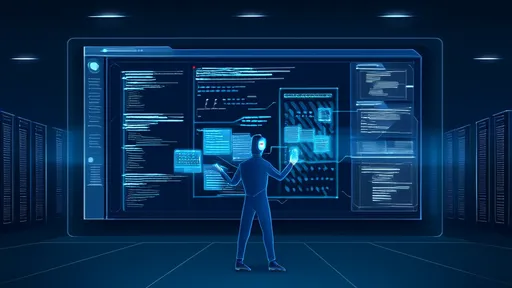
Compiler technology sits at the heart of modern computing, yet its inner workings often remain shrouded in mystery for many developers. A new wave of interactive learning tools is changing this landscape by allowing programmers to experiment with compiler components in real-time. These digital laboratories provide hands-on experience with lexical analysis, parsing, optimization, and code generation—the fundamental stages that transform human-readable code into machine-executable instructions.
The traditional approach to learning compiler design involved dense textbooks and static diagrams. Today's interactive platforms visualize the compilation pipeline as a dynamic process where users can modify inputs and immediately observe how changes ripple through each compilation phase. This experimental method reveals nuances that theoretical study alone cannot convey—how subtle syntax alterations affect abstract syntax trees or how optimization passes reshape intermediate representations.
Visualizing the Lexical Analysis Phase
One particularly effective demonstration shows how scanners break source code into meaningful tokens. Users can type programming statements and watch as the lexer highlights different token categories—keywords glowing blue, identifiers turning green, literals pulsing yellow. The interface exposes edge cases that challenge tokenization rules, such as distinguishing between the greater-than operator and a right angle bracket in template syntax. These visual cues help cement understanding of regular expressions and finite automata in a way that static examples cannot.
The parsing stage comes alive when users can manipulate production rules and watch the parser's stack operations in sync with the input stream. Interactive tools demonstrate why certain grammars require lookahead or how left recursion causes immediate problems. Some platforms even allow switching between parsing algorithms—comparing recursive descent's straightforward implementation with the table-driven efficiency of LR parsers. This side-by- comparison illuminates the engineering tradeoffs compiler designers face.
Optimization as a Playground
Modern compiler experiments particularly shine when demonstrating optimization techniques. Users can submit small functions and apply different optimization passes individually—watching constant propagation eliminate variables, seeing loop invariant code motion restructure iterations, or observing how dead code elimination strips away unnecessary operations. The ability to toggle optimizations on and off while viewing the resulting assembly creates profound "aha" moments about performance implications.
Advanced platforms incorporate architecture simulators that show how compiler decisions affect actual processor behavior. Pipeline stalls become visible when instructions lack proper scheduling, and cache miss patterns emerge from poor memory access patterns. These visualizations connect compiler theory with tangible performance outcomes—demonstrating why certain optimizations matter more for superscalar architectures or why vectorization can yield dramatic speedups.
The code generation phase benefits tremendously from interactive exploration. Users can modify register allocation strategies and immediately see spill code consequences. Some tools highlight the lifetime of variables across basic blocks or illustrate how different instruction selection approaches yield varying machine code densities. These experiments make tangible the challenges of targeting real instruction sets with their irregular constraints and special-case operations.
Beyond Traditional Compilers
Innovative platforms are extending these interactive principles to modern language processing scenarios. Web-based tools demonstrate transpilation between JavaScript versions, showing how modern syntax desugars into compatible ES5 code. Others visualize the type checking process for gradually typed languages or show how type inference propagates through complex expressions. These experiments bridge the gap between classical compiler theory and contemporary language toolchains.
The most sophisticated learning environments incorporate version control for compiler experiments, allowing users to track how their modifications affect compilation outcomes. Some integrate performance profiling directly into the interface—comparing execution times across different optimization levels. Others include collaborative features where learners can share interesting compilation cases or challenge peers to create the most optimized version of a code snippet.
As these interactive tools mature, they're reshaping compiler education from a passive lecture subject into an experimental science. Students no longer just learn about compilers—they experience the satisfaction of seeing their optimizations reduce instruction counts or their grammar modifications enable new language features. This hands-on approach produces deeper understanding and prepares developers to contribute to real-world compiler projects with practical intuition about the compilation pipeline's delicate balance between correctness, performance, and maintainability.
The future points toward even richer interactions—possibly integrating machine learning techniques that suggest optimizations or detect antipatterns. Some experimental platforms already allow modifying virtual machine designs to explore how compiler strategies must adapt to different execution environments. As compiler technology continues evolving to handle new paradigms like quantum computing or heterogeneous architectures, these interactive laboratories will serve as essential training grounds for the next generation of language implementers.

By /Jul 11, 2025

By /Jul 11, 2025

By /Jul 11, 2025

By /Jul 11, 2025

By /Jul 11, 2025

By /Jul 11, 2025

By /Jul 11, 2025
By /Jul 11, 2025

By /Jul 11, 2025
By /Jul 11, 2025

By /Jul 11, 2025

By /Jul 11, 2025

By /Jul 11, 2025

By /Jul 11, 2025

By /Jul 11, 2025

By /Jul 11, 2025

By /Jul 11, 2025

By /Jul 11, 2025