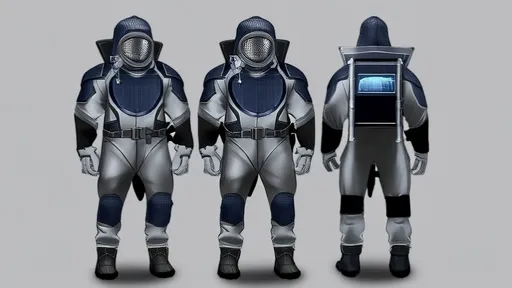
The concept of climate migration has moved from speculative fiction to urgent reality as extreme weather events displace millions annually. Among the most innovative responses to this crisis is the development of Extreme Environment Adaptive Suits (EEAS) – a new generation of wearable technology designed to protect climate refugees during perilous journeys across inhospitable terrains. These suits represent a fusion of cutting-edge material science, biometric monitoring, and climate-responsive design that could redefine human resilience in the face of environmental catastrophe.
Unlike traditional survival gear, EEAS incorporates phase-change materials that dynamically adjust insulation properties based on external temperatures. In scorching deserts, the suit's outer layer reflects solar radiation while capillary action draws sweat away from the skin. When facing sub-zero conditions during mountain crossings, the same material expands to create insulating air pockets. This adaptability stems from research originally conducted for Mars colonization projects, now repurposed for terrestrial survival scenarios.
The respiratory system represents another breakthrough, featuring nanoparticle filters that neutralize airborne toxins from wildfires or industrial pollution. During sandstorms, electrostatic fibers create a protective barrier around the headpiece while maintaining oxygen flow. Perhaps most remarkably, certain prototype models integrate genetically modified algae symbionts that can supplement oxygen production in oxygen-deprived environments – though this controversial biotechnology remains in limited testing due to ethical concerns.
Mobility challenges in climate migration have driven innovative exoskeleton designs. Lightweight carbon-fiber frames provide support during long treks while harvesting kinetic energy to power the suit's systems. The latest iterations include terrain-responsive soles that stiffen for rock climbing or soften for swamp crossings, using a technology adapted from military applications. These features address the cruel reality that climate refugees often traverse multiple extreme environments during their journeys – from flooded deltas to drought-stricken plains – sometimes within the span of a single week.
Water procurement has seen particularly ingenious solutions. The suits incorporate atmospheric water harvesters capable of extracting up to three liters daily from humid air, supplemented by forward-osmosis patches that can purify contaminated water sources. Testing in the Sahel region demonstrated these systems' ability to sustain users for 72 hours without external water sources – a critical timeframe during border crossings where water stations may be unavailable or unsafe.
The psychological dimension of climate migration hasn't been overlooked. The inner lining features biometric sensors that detect stress hormones and release calming neurochemical analogs through transdermal patches. While not replacing proper mental health care, this feature aims to prevent panic attacks during dangerous crossings. Some humanitarian organizations have raised concerns about potential misuse of such mood-altering technology, advocating for strict ethical guidelines in its deployment.
Connectivity features transform the suits into mobile survival hubs. Mesh networking allows refugee groups to maintain contact when cellular infrastructure fails, while emergency beacons transmit locations to aid organizations. The controversial integration of blockchain technology enables verified identity preservation – critical for stateless climate refugees needing to prove their origins when seeking asylum. This has sparked debates about data privacy versus the necessity of digital identification in an increasingly border-controlled world.
Manufacturing challenges remain significant. While prototype costs have dropped from initial $20,000 estimates to around $3,000 per unit, mass production for vulnerable populations requires further economies of scale. Several NGOs have partnered with sportswear manufacturers to adapt existing production lines, though compromises in functionality are inevitable. The ethical dilemma of creating "tiered" suit versions based on recipients' wealth threatens to mirror the very inequalities that make climate change disproportionately affect the poor.
Field tests in climate hotspots have yielded both promising results and sobering realities. In Bangladesh's flood zones, the suits' flotation systems saved numerous testers during sudden inundations. However, cultural barriers emerged when traditional garments couldn't be worn over the suits, leading to modifications incorporating modular outer layers. The most heartbreaking limitation remains that no technology can address the root causes forcing migration – these suits merely make survival marginally less impossible.
As climate projections grow increasingly dire, the EEAS initiative forces society to confront difficult questions. Does developing survival technology represent adaptation or resignation? Can innovation ever compensate for lost homelands? The suits may symbolize both human ingenuity and collective failure – a stopgap measure for civilizations unwilling to prevent the crisis in the first place. Their existence serves as a stark reminder that the climate emergency has progressed beyond theoretical discussions into an era requiring literal life-support systems for displaced populations.
The coming decade will determine whether such technologies remain specialized equipment or become mass-produced necessities. With current displacement projections estimating up to 1.2 billion climate migrants by 2050, the scale of need threatens to overwhelm even the most advanced technological solutions. Perhaps the ultimate test won't be whether the suits function as designed, but whether humanity can render them obsolete through meaningful climate action before they become standard issue for an increasingly nomadic species.

By /Jul 16, 2025

By /Jul 16, 2025
By /Jul 16, 2025

By /Jul 16, 2025

By /Jul 16, 2025

By /Jul 16, 2025
By /Jul 16, 2025

By /Jul 16, 2025

By /Jul 16, 2025

By /Jul 16, 2025

By /Jul 16, 2025
By /Jul 16, 2025
By /Jul 16, 2025
By /Jul 16, 2025

By /Jul 16, 2025

By /Jul 16, 2025

By /Jul 16, 2025

By /Jul 16, 2025