Feather Painting as Intangible Cultural Heritage: Modern Application of High-Temperature Pyrography

Jul 16, 2025 By

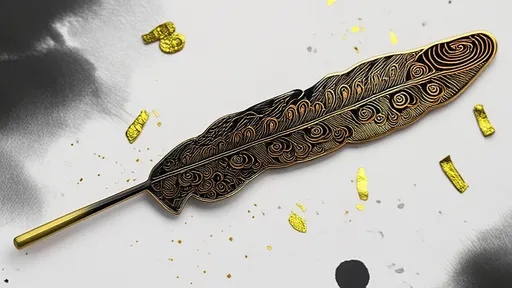
The ancient art of fire painting, known as "huo hua" in Chinese, has been revitalized through the innovative application of high-temperature pyrography on feathers. This intangible cultural heritage technique, once reserved for traditional scrolls and wooden surfaces, has found a surprising modern niche in contemporary art and design. Artists now manipulate heated tools to create intricate, permanent designs on delicate feathers, merging fragility with durability in a way that challenges conventional artistic boundaries.

At the heart of this revival lies the paradoxical nature of the medium. Feathers, typically associated with softness and impermanence, become enduring canvases when subjected to precise thermal treatment. The process requires not only artistic skill but also a deep understanding of material science. Master craftsmen have developed techniques to control heat intensity down to individual barbules, allowing for gradients of color from light sepia to deep espresso that rival watercolor paintings in their subtlety.

The modern applications of this art form span far beyond decorative pieces. Fashion houses have incorporated pyrographed feathers into haute couture collections, where the contrast between the organic material and precise geometric patterns creates striking visual tension. Interior designers commission large-scale installations featuring feather mosaics treated with varying heat levels to produce intricate shadow effects when backlit. Perhaps most unexpectedly, the technique has entered the realm of musical instrument craftsmanship, with luthiers using treated feathers to create unique soundboard textures that allegedly alter acoustic properties.

Scientific research has begun to uncover why this ancient method works so well on avian plumage. The keratin proteins in feathers undergo complex molecular rearrangements when exposed to controlled heat, creating stable pigmentation without the need for artificial dyes. This discovery has led to collaborations between artists and materials engineers, exploring potential applications in sustainable manufacturing. The resulting artworks possess an archival quality that paper-based pyrography cannot match, with some museum specimens showing no degradation after decades of display.

Contemporary practitioners face unique challenges that their predecessors never imagined. Each bird species' feathers react differently to heat, requiring artists to maintain extensive databases of thermal properties. The ethical sourcing of feathers has become paramount, with most artists now working exclusively with molted feathers or byproducts from regulated food production. Some studios have even developed "cold pyrography" techniques using precise lasers to achieve similar effects without actual combustion, though purists argue this loses the essential "fire energy" central to the tradition.

The global art market has responded enthusiastically to these innovations. Auction records for masterworks in this medium have quadrupled in the past decade, with particularly strong interest from collectors of sustainable contemporary art. Major exhibitions often feature interactive elements where visitors can observe the creation process through magnifying lenses or thermal imaging cameras, revealing the astonishing precision involved. Educational programs have emerged worldwide, though true mastery still requires the kind of prolonged apprenticeship that defines traditional intangible cultural heritage transmission.

Technological integration has pushed the boundaries further. Some artists now incorporate micro-encapsulated thermochromic pigments that react to body heat when feathers are worn as jewelry, creating living artworks that change throughout the day. Others embed conductive carbon traces burned into the feather's structure, allowing touch-sensitive installations or even functional musical interfaces. These developments have sparked debates about how far the form can evolve while maintaining its cultural authenticity - a tension familiar to many traditional arts navigating modernity.

Environmental considerations have shaped the art's contemporary practice in profound ways. The carbon footprint of electric pyrography tools has led some artists to return to ancient methods using solar-concentrated heat or biodegradable heat sources. The feathers themselves, being natural materials, offer complete biodegradability - an increasingly valued quality in the art world. This ecological dimension has attracted collaborations with conservation organizations, using feather artworks to raise awareness about avian biodiversity loss.

Looking forward, the intersection of this ancient technique with cutting-edge technology promises even more remarkable applications. Research is underway into medical uses, exploring whether the precise thermal modification of feather keratin could inspire new biomaterials. Meanwhile, the digital art world has taken notice, with NFT creators seeking ways to authenticate physical feather pyrography as accompanying assets to blockchain tokens. Through all these developments, the core appeal remains: the mesmerizing alchemy of transforming something ephemeral into enduring beauty through the controlled application of fire's transformative power.

The story of high-temperature feather pyrography exemplifies how traditional crafts can find renewed relevance in unexpected ways. Rather than being preserved as static museum pieces, such intangible cultural heritage techniques thrive through adaptation and cross-pollination with contemporary concerns. As artists continue to push the boundaries of what's possible with heated tools and avian canvases, they write new chapters in a story that began centuries ago - proving that some traditions don't belong in the past, but rather evolve to illuminate the future.
Recommend Posts
Fashion

23 Extinct Edge-Finishing Techniques on the Brink of Disappearance

By /Jul 16, 2025

The art of hand-stitched hemming, once a cornerstone of textile craftsmanship, now teeters on the brink of obscurity. Among the countless techniques developed over centuries, twenty-three distinct hemming methods face imminent extinction. These intricate approaches to fabric finishing, each with unique structural and aesthetic qualities, represent vanishing chapters in the story of human ingenuity with needle and thread.
Fashion

The World Atlas of Fasteners: From Bone Needles to Smart Magnetic Buckles

By /Jul 16, 2025

The history of fasteners is a fascinating journey through human ingenuity, mirroring our technological and cultural evolution. From prehistoric bone needles to modern magnetic smart closures, these humble devices have quietly shaped civilizations by holding together everything from clothing to spacecraft. The story of fasteners reveals how humanity has continuously reinvented the way we connect materials - and by extension, how we live.
Fashion

Bamboo Silk Inlaid Bag: 0.1mm Bamboo Silk Weaving Technique

By /Jul 16, 2025

In the world of traditional craftsmanship, few materials are as versatile and sustainable as bamboo. Among the many techniques developed over centuries, the art of weaving bamboo threads as fine as 0.1mm stands out as a testament to human ingenuity. This delicate process, known as bamboo silk weaving, has been perfected by artisans who transform humble bamboo into exquisite pieces of functional art.
Fashion

Eggshell Glaze Technology: Transplanting Ceramic Craftsmanship to Buttons

By /Jul 16, 2025

The art of ceramics has long been revered for its delicate beauty and intricate craftsmanship. Among its many techniques, eggshell glazing stands out as a particularly refined method, producing surfaces with a luminous, translucent quality reminiscent of porcelain. Now, this ancient ceramic tradition is finding new life in an unexpected domain: button manufacturing. The transplantation of eggshell glazing techniques onto buttons represents a fascinating convergence of heritage craftsmanship and contemporary design, yielding products that are as visually striking as they are tactilely pleasing.
Fashion

Bark Cloth 2.0: Nano-Reinforced Natural Fibers

By /Jul 16, 2025

The world of sustainable materials is witnessing a quiet revolution with the emergence of Barkcloth 2.0 – a next-generation iteration of the ancient fabric now supercharged with nanotechnology. This isn’t just another eco-friendly textile; it’s a paradigm shift in how we perceive the strength and versatility of plant-based fibers. Researchers and material scientists are redefining the boundaries of natural materials by embedding nanocellulose structures within traditional barkcloth, resulting in a composite that rivals synthetic fabrics in durability while retaining its biodegradable essence.
Fashion

Fish Scale Sequin Crafts: Recycling Fishery Waste into Sparkling Materials

By /Jul 16, 2025

The fashion and design industries have long been criticized for their environmental footprint, but a surprising innovation is emerging from an unlikely source: fish scales. Across coastal communities and research labs, scientists and designers are collaborating to transform fishery byproducts into dazzling, sustainable materials that could revolutionize everything from haute couture to automotive finishes.
Fashion

Feather Painting as Intangible Cultural Heritage: Modern Application of High-Temperature Pyrography

By /Jul 16, 2025

The ancient art of fire painting, known as "huo hua" in Chinese, has been revitalized through the innovative application of high-temperature pyrography on feathers. This intangible cultural heritage technique, once reserved for traditional scrolls and wooden surfaces, has found a surprising modern niche in contemporary art and design. Artists now manipulate heated tools to create intricate, permanent designs on delicate feathers, merging fragility with durability in a way that challenges conventional artistic boundaries.
Fashion

Metaverse Skin Library: Digital Asset Materialization Platform

By /Jul 16, 2025

The concept of the metaverse has evolved from science fiction to a tangible digital frontier, and with it comes the need for innovative platforms that bridge the gap between virtual and physical worlds. One such groundbreaking development is the emergence of the Metaverse Skin Vault, a digital asset materialization platform that allows users to transform their virtual identities, wearables, and collectibles into real-world objects. This fusion of digital and physical realms is redefining ownership, creativity, and commerce in ways previously unimaginable.
Fashion

Vertical Farming Coveralls: Built-in Crop Growth Monitoring

By /Jul 16, 2025

The concept of vertical farming has long been touted as a revolutionary solution to urban food production, but recent innovations are pushing the boundaries even further. One such breakthrough is the integration of crop growth monitoring directly into the fabric of vertical farming systems—literally. The emergence of "smart coveralls" or vertical farming smocks equipped with embedded sensors is transforming how growers interact with their crops. These high-tech garments are not just protective clothing; they are becoming an essential tool for real-time data collection and analysis in controlled environment agriculture.
Fashion

Deep-Sea Exploration Gown: Pressure-Resistant Luminous Evening Wear

By /Jul 16, 2025

In the ever-evolving world of fashion, where creativity knows no bounds, a groundbreaking concept has emerged from the depths of inspiration—literally. The Deep-Sea Exploration Gown: A Pressure-Resistant, Glowing Evening Attire is not just a garment; it’s a marvel of engineering and design, blurring the lines between haute couture and advanced technology. This innovative creation draws its essence from the mysterious and uncharted territories of the ocean, translating the resilience and luminescence of deep-sea creatures into a wearable masterpiece.
Fashion

Lunar Colony Workwear: Dustproof Design for the Moon

By /Jul 16, 2025

The dream of establishing a permanent human presence on the Moon is inching closer to reality, but one of the most persistent obstacles remains lunar dust—a fine, abrasive, and electrostatically charged material that clings to everything it touches. Engineers and designers working on lunar colonization workwear are now prioritizing advanced sealing technologies to protect astronauts and equipment from this pervasive threat. Unlike Earth’s relatively benign dust, lunar regolith poses unique dangers due to its jagged structure and lack of erosion, making traditional sealing methods insufficient.
Fashion

Climate Migrant Uniform: Self-Adaptive Suit for Extreme Environments

By /Jul 16, 2025

The concept of climate migration has moved from speculative fiction to urgent reality as extreme weather events displace millions annually. Among the most innovative responses to this crisis is the development of Extreme Environment Adaptive Suits (EEAS) – a new generation of wearable technology designed to protect climate refugees during perilous journeys across inhospitable terrains. These suits represent a fusion of cutting-edge material science, biometric monitoring, and climate-responsive design that could redefine human resilience in the face of environmental catastrophe.
Fashion

Paleontological Fossil Rubbing: Lithic Texture Transfer Technology

By /Jul 16, 2025

The art of transferring fossil impressions and rock layer textures onto paper or other surfaces has long fascinated paleontologists and artists alike. Known as fossil rubbing or rock texture transfer, this technique bridges the gap between scientific documentation and aesthetic expression. Unlike traditional photography or 3D scanning, it captures minute details through direct physical contact, preserving the tactile essence of ancient surfaces.
Fashion

Deconstructivist Scaffold Earrings: Architectural Accessorization"

By /Jul 16, 2025

The fashion world has always drawn inspiration from the most unexpected places, but few could have predicted the rise of scaffolding earrings as the latest avant-garde statement. These architectural accessories, borrowing their form from industrial construction sites, have become the darlings of deconstructionist designers and street-style icons alike. What began as a niche experiment in materiality has blossomed into a full-blown movement challenging conventional notions of jewelry design.
Fashion

Herbal Scent Sachet Lingerie: Microcapsule Slow-Release Herbal Ingredients

By /Jul 16, 2025

The fusion of traditional Chinese medicine with modern textile technology has birthed an innovative product category: herbal-infused lingerie embedded with microencapsulated botanical extracts. This groundbreaking approach to intimate apparel combines centuries-old wisdom with 21st-century material science, creating garments that promise not just comfort but potential therapeutic benefits.
Fashion

Violin Resonance Box: Instrument Structure Sound Amplification Device

By /Jul 16, 2025

The violin, with its rich tonal qualities and expressive capabilities, owes much of its acoustic brilliance to the intricate design of its soundbox. Often referred to as the "resonance chamber" or "body," this hollow structure serves as the primary amplifier of vibrations produced by the strings. Unlike electronic instruments that rely on external speakers, the violin's soundbox is a marvel of natural acoustics, meticulously crafted to project sound with clarity and warmth. The relationship between the violin's structural components and its sonic output has fascinated luthiers and musicians for centuries, making it a subject worthy of exploration.
Fashion

Astronomical Lens Sunglasses: Transfer of Telescope Coating Technology

By /Jul 16, 2025

The world of optics is witnessing a fascinating crossover as telescope coating technologies make their way into the realm of everyday eyewear. What was once reserved for high-powered observatory instruments is now enhancing the performance of premium sunglasses. This unexpected marriage of astronomy and fashion is redefining how we think about sun protection and visual clarity.
Fashion

Autism Sensory Clothing: Pressure Feedback Soothing System

By /Jul 16, 2025

For individuals on the autism spectrum, sensory processing challenges can turn everyday environments into overwhelming experiences. The constant barrage of stimuli—bright lights, loud sounds, or unexpected textures—can trigger anxiety, meltdowns, or withdrawal. In recent years, a groundbreaking innovation has emerged to address these challenges: sensory garments with integrated pressure feedback systems. These wearable technologies are not just clothing; they are therapeutic tools designed to provide deep-pressure stimulation, a proven method for reducing sensory overload and promoting emotional regulation.